Andrew Miller is the International Director of DMI. When he’s not eating Doritos in Sydney, he’s travelling around the world raising funds and DMI’s profile in developed countries or visiting the fields we support to see what’s needed and how our funds are being managed. Either way, he works tirelessly to avoid unidentifiable food and meets lots of weird and wonderful people who he just can’t resist interviewing…
#25 Josephat
Josephat Mulongo is the director of Deaf Action Kenya (DAK), DMI’s partnering organisation in Kenya. I caught up with him earlier this year at the DMI conference in the Philippines, with Gunnar interpreting (hopefully accurately).
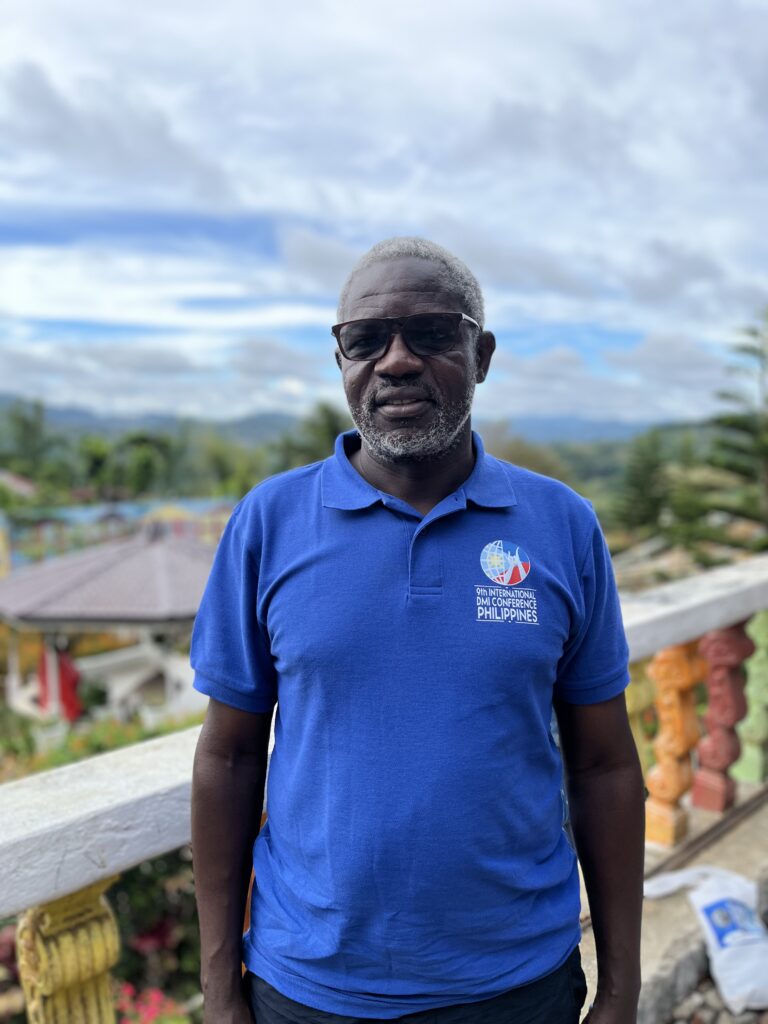
Andrew: You are the director of Deaf Action Kenya (DAK). How long have you had that role?
Josephat: I started as Director in 2002. I’ve been leading the work in various areas of Kenya ever since.
And I believe Kenya was the first country in Africa where DMI began to minister, is that right?
Yes, that’s right.
Can you tell me a bit about that beginning?
It had an interesting start! It began with a hearing impaired pastor named Joseph Mugo who met Neville and told him that every Deaf person will burn in hell because they will never hear the Word of God. Neville was so outraged, his heart was so moved, that he wanted to go to Africa immediately to share the gospel with the Deaf – and he did. He began in Kenya, and from there the ministry has spread into many countries across Africa.
When did you come to Christ and when did you begin in Christian ministry?
I became a Christian in 1984. I was 16 years old and I started in ministry in 1991.
Can you tell me more about how you came to Christ? Why did you become a Christian?
I was attending a school for the Deaf. Pastor Daniel came and preached to us. He told us about Jesus and about the devil, and he said that the devil was a liar and a thief. He said if we were living in sin, then we were like friends with the devil. He challenged us to humble ourselves and to turn our lives over to Jesus. I decided to receive Jesus and was baptised.
Is it true that you are the first or one of the first Deaf in Kenya to study theology?
No, I was the fourth. But I was the first Deaf person to be recognised as an ordained reverend by the Kenyan government.
Were you born deaf?
No.
So can you tell me about your deafness?
I was born hearing and I could speak but in Year 8 in school I was having some problems with my homework. The teacher became furious with me and he hit me again and again and again in my head. At that time I also contracted malaria. I was taken to the hospital with a sore head and feeling sick, and was treated for a couple of weeks. My legs were so weak I couldn’t walk. I remember being given lots of pills and many injections. Eventually I could walk again but my hearing was gone.
How did that change your school life and your family life?
The major change was my school life. It was hard. But communication was actually harder at home than at school and my mother always encouraged me in my schoolwork so I was able to progress quite well there.
So your parents never learned to sign? How about your siblings?
No, no one in my family became proficient in sign – except for my last-born sibling, my sister Lucy. I have a twin sister, but she never really learned to sign.
Does it bother you that none of the others learnt to sign to communicate with you?
I wouldn’t say it was hard, but the reality was that we didn’t communicate very much. If we did it was through a little reading and writing, but you know in those days nobody – not the government or anybody – encouraged families to learn sign language when they had a deaf child.
What are the greatest challenges or obstacles to DAK further developing its ministry?
One of the greatest challenges is government bureaucracy. It has been a hard and long process to get an official document from the government for Deaf Action Kenya and what makes it even harder is that the policies of the government keep changing. But I do think now we have a good foundation for developing the work further.
Has it been difficult working with Gunnar?
Very. [Gunnar laughs]
Oh! Please explain!
No, no, no I was just kidding. I work closely with Gunnar and that has been so good. He has been guiding me for many years in my mission work and I’ve learned so many things from him. He has taught me and led me like a father. I have faced many problems over the years but I’ve always been able to consult Gunnar and he’s always been there for me.
What do you think have been DAK’s greatest achievements to date?
The biggest achievement has been all the Deaf who have received Christ. We have seen so many Deaf people not only saved but going into ministry as pastors and evangelists. Some have even traveled as missionaries like Jeremiah to Uganda and Daniel who went to Tanzania and established the ministry there which has become so powerful today.
What is your hope for DAK’s future?
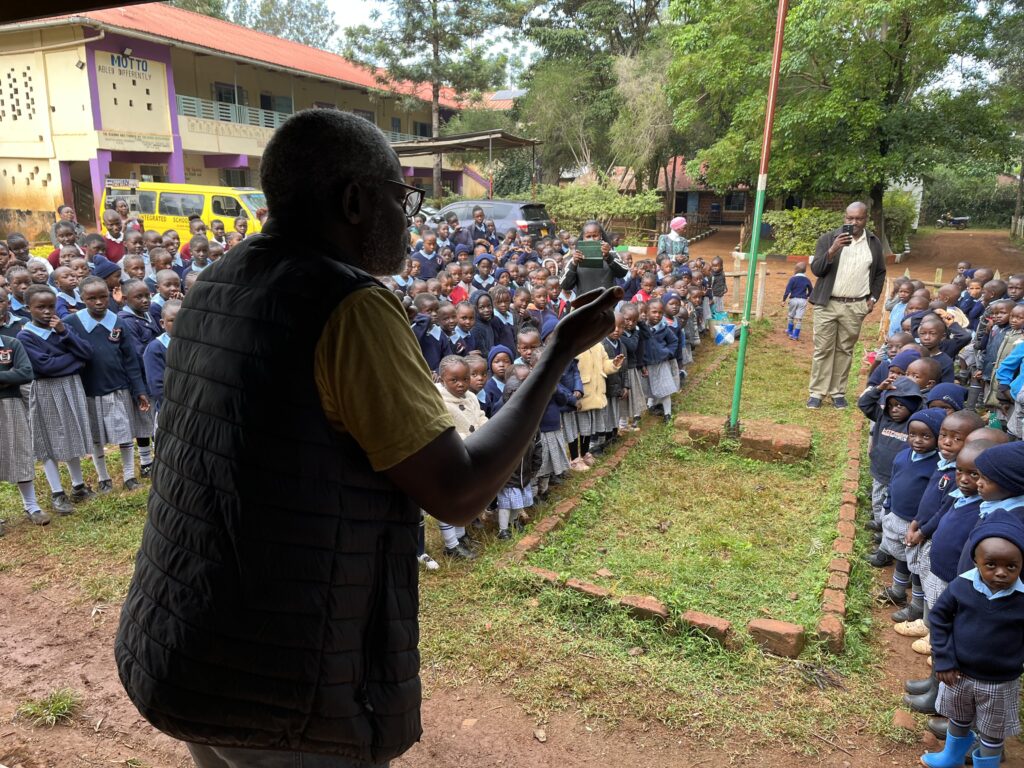
We have a big goal at the moment and that is to build a church for the Deaf in Nairobi. It will not just be a church but a place to raise evangelists, to train the Deaf in business practices and trades through DMI’s micro loan program. It will be a centre to enrich the lives of the Deaf and to spread the gospel to the Deaf right across Kenya.
That’s a promising goal for DAK. As the senior representative of DMI Africa, what do you think about DMI’s future? What would you like to see DMI accomplish going forward?
I hope that DMI will continue to support our work financially in Kenya and across the African continent because that support is essential. At the same time, I’m aware of how important it is for Kenya to be more self sustainable.
Can you be more specific about that? How do you think DAK can become more self-sustainable?
I think this can be achieved both through more individuals receiving micro loans and establishing their own businesses to become self-sufficient, and also through organisational loans to develop larger-scale community projects.
Any final questions or comments?
We’ve talked about finance and loans and that’s important but what we really need are prayers and words of encouragement. The relationship we have with DMI is key to these as well as mature guidance on leadership issues. We need DMI’s help to build for the future – like enabling our students to attend the new Bible college in Rwanda.
Thank you for the incredible work you are doing in Kenya and across Africa.
Oh, thank you and all the DMI supporters!
~
If you would like to support DMI’s work in Kenya, click here or on the donate button below.
Lovely to read these interviews. It would be even better to have videos. If that is ever possible, so it is more visual and so we can see the different sign languages 🙂
Doesn’t need to be a perfect slick video, just filmed on a phone and edited so its not too long.
With love, Esther x